
What Bannock County Deed Records Preserve
The Bannock County Clerk/Recorder keeps the county's title trail. Its deed records show who signed as grantor and grantee, the land description carried by the instrument, and the recording reference a searcher needs to pull the original. The instrument type matters, too. A warranty deed, a quitclaim deed, and a deed issued after a tax sale each make different promises and grow out of different events, so the label on the document tells you what it can and cannot prove about ownership.
| Instrument | What it does | Typical setting |
|---|---|---|
| Warranty deed | Conveys an interest with title promises | Ordinary purchase |
| Quitclaim deed | Conveys only the interest the grantor may have | Family, trust, or title cleanup |
| Personal representative deed | Conveys through an estate representative | Probate administration |
| Trustee deed | Conveys through a trustee's stated authority | Trust administration or foreclosure |
| Tax deed | Records a transfer after the tax process | Delinquent-tax property |
A mortgage or deed of trust is not an owner transfer. It is an encumbrance. Idaho follows lien theory. That means the security instrument creates a lien on the land rather than transferring title to a lender. Watch for a later release or reconveyance, since that document shows the debt was discharged.
The Bannock Index Starts With Its Disclaimer
The Self-Service land-record portal greets you with an acceptance screen before anything else. The index is described as a catalogue-like aid. Entries may change, and the underlying document always controls. Users are told to try spelling variations and different search criteria. The official Recorder disclaimer presents that gateway in full. The post-acceptance filters are not spelled out. So treat no address, parcel, date, or document-type filter as a promise until you open the portal yourself.
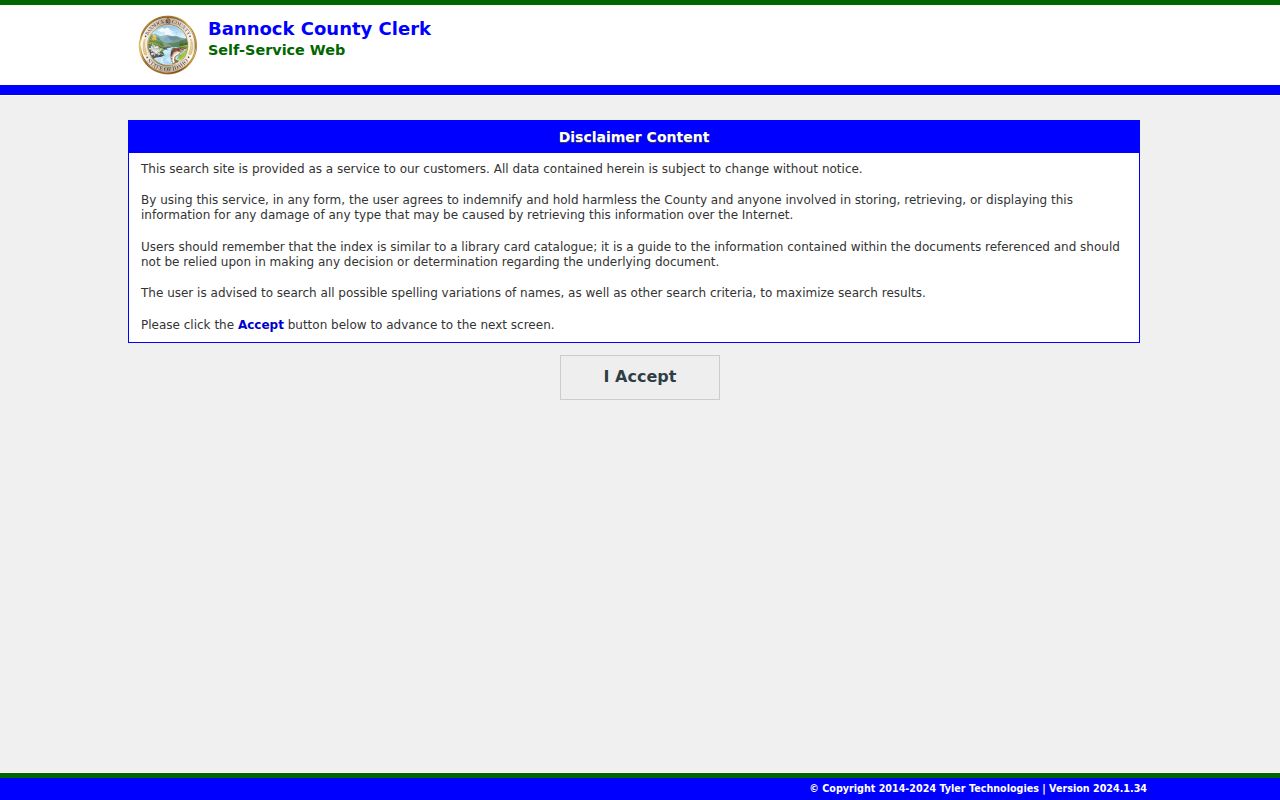
After accepting the terms, test every relevant party-name form and open the image. A blank result does not prove that no Bannock County deed exists. Note: Keep the portal's warning in mind when names are misspelled, abbreviated, or indexed through a trust or estate.
Walk the Bannock Grantor-Grantee Chain
The grantor conveys the stated interest. The grantee receives it. A chain of title is simply the linked series of transfers affecting the same land, run in order. Start from the name on the current assessor roll, but stay alert for a lag, since the roll may not reflect a very recent sale right away.
- Search the current owner as grantee. For a recent sale, also search the prior roll owner as grantor.
- Read the actual deed for its grantor, grantee, execution and recording dates, legal description, and instrument reference.
- Search that grantor as an earlier grantee. Match the legal description rather than relying on a common name.
- Repeat backward, checking probate, trustee, plat, or name-variant records when the sequence appears to break.
- Move to older deed books, microfilm, the Recorder counter, or archives when the online images end.
- Instrument number
- The unique reference used to retrieve a recorded filing.
- Book and page
- A volume reference used where an older record actually displays it.
- Legal description
- The land description that ties successive records to the same property.
- Chain of title
- The ordered connection among recorded transfers, subject to legal review.
Idaho Recording Rules Shape the Deed
Idaho Code §31-2402.1 describes the recorder's authority for deeds and grants. It also covers transfers, mortgages, releases, powers of attorney, and leases. Idaho Code §§55-801 and 55-808 address recordability and the proper county for recording. Under Idaho Code §55-601, an instrument generally needs the grantee's name and full mailing address. The legal description identifies the affected land.
The public parcel layer includes DEED and OLD_DEED fields. Those are only leads to Bannock County deed records. The parcel schema lists no sale-price field. Consideration language, exceptions, acknowledgments, and complete party descriptions live in the image itself.
The 1999 Imaging Statement Has a Limit
The Clerk/Recorder states that land records created since 1999 are scanned. They are viewable online by clerks and the public. That is a real service. But it does not publish the exact first online index year, and it does not guarantee that every earlier entry or image can be pulled remotely.
Older Bannock County deed records may live in the recorder vault, in deed books, or on microfilm. Some may be held at the Idaho State Archives. Archives holdings vary by series. Bring party names, an approximate year, the legal description, and any book or instrument reference you have.
Scanned since 1999 is not complete historical coverage. Use the Recorder's counter or archival sources when an older deed chain disappears online.
Liens and Court Notices Sit Beside Deeds
The recorder's holdings reach well beyond deeds. They include mortgages and trust deeds. They also cover assignments, releases, reconveyances, judgment liens, mechanic's liens, and lis pendens notices. A lis pendens signals pending litigation that may affect land. This is why a deed list alone may not resolve the full title trail.
When a filing points to foreclosure, quiet title, partition, probate, or lien enforcement, search the public case index through Idaho iCourt Smart Search. The Sixth District clerk can supply a public case document when needed. A court docket and a recorded land notice are related sources, not substitutes. Note: Match each release to the lien or trust deed it discharges. The presence of both records is often the useful fact.
Plats Give Lot-and-Block Deeds Their Map
A deed that names a subdivision, lot, and block depends on the recorded plat. The plat gives the deed its mapped framework. Bannock County records plats and surveys, while the GIS map serves as a reference display. Follow the deed's plat reference before assuming the modern tax shape matches an original lot.
The fee schedule is specific. Survey filing runs $5 per page. A survey or highway right-of-way plat copy costs $4. A town plat or map is $11 for the first 100 lots. It adds five cents per additional lot. These are record fees, not the charge for a private boundary survey.
Get a Bannock Deed Image or Certified Copy
Use the online image when one is available. The Clerk/Recorder also serves the public at 624 E Center Street, Room 211, Pocatello, Idaho 83201, from 8 a.m. to 5 p.m. on weekdays except state holidays. Call 208-236-7358 with the parties, the date range, and the instrument reference. When a record is not exposed online, the county's public-record request route is available.
Copy charges are listed as $1 per copy page, five cents per page or image for recurring electronic copies, and $1 for a certificate under seal. Recording a deed, grant, or conveyance of 30 pages or fewer costs $15. A standard non-special filing runs $10 for the first page and $3 for each added page. A trust deed or mortgage of 30 pages or fewer costs $45, while a reconveyance or release costs $15.
Recorded does not mean guaranteed title. The index shows accepted filings, not a legal opinion that title is clear. Unrecorded interests and indexing errors may exist.
Bannock's Fraud Alert Adds a Watch Step
Bannock County's Clerk/Recorder offers a deed-fraud alert for enrolled owners. When a newly recorded document contains matching details, the alert flags it. The owner then has a reason to pull the filing and read it closely. The alert itself stops nothing. It cannot block a recording or rule any instrument fraudulent.
Signup fields and matching rules can change. Confirm the current terms with the Clerk/Recorder. A document you never expected may show up in the property records. Get a copy of it first. Then take the matter to the proper official or legal channel. Do not confront anyone by name.
Probate Can Bridge a Break in Bannock Deeds
A clean Bannock County deed chain can look like it ends when an owner dies. It usually does not. Probate supplies the missing link. The link often comes through a personal representative deed, a trustee instrument, a court decree, or an heirship affidavit tied to estate administration. Search both names, the decedent and the representative. The legal description then keeps every result tied to the same parcel of land. Idaho iCourt may surface a public probate case. The Recorder holds any instrument that entered the land records.
A probate docket is not a conveyance by itself. Read the order next to the later deed. Check whether the estate transferred the full interest or just the decedent's share. That distinction matters when several heirs, a trust, or a life estate appears in Bannock County deed records.
The Recorder also keeps powers of attorney and water-right filings. A power of attorney can explain why one person signed for another. A water-right record may attach to the land's use without matching fee ownership. Compare parties, dates, and legal descriptions before adding either document to your chain of title.