
Build the Bannock County Deed Chain Backward
The Bannock County Clerk/Recorder anchors the legal record of every transfer. Build your working table from actual instruments, never from assumed owners.
| Transfer date | Grantor to grantee | Instrument | Land key |
|---|---|---|---|
| Newest recording | Prior owner to present grantee | Read deed type from the record | Legal description and deed reference |
| Next earlier recording | Earlier owner to that prior grantee | Match the indexed instrument | Same land description |
| Older book entry | Earlier grantor to grantee | Book, page or image as held | Lot, block, section or metes and bounds |
Do not fill in dates or book references yet. The blank-chain method keeps missing links visible and stops a name match from turning into an invented transfer.
The Bannock Recorder's 1999 Imaging Marker
Bannock County says land records created since 1999 are scanned and publicly viewable online. That is an imaging statement. It does not promise that every index field begins on January 1 of that year, and the county publishes no exact earliest year for the online index.
Searches start at the Self-Service land-record portal after accepting its disclaimer. The portal calls its index a catalogue that may change. It never replaces the deed itself. Try initials, full names, entity suffixes and spelling variants.
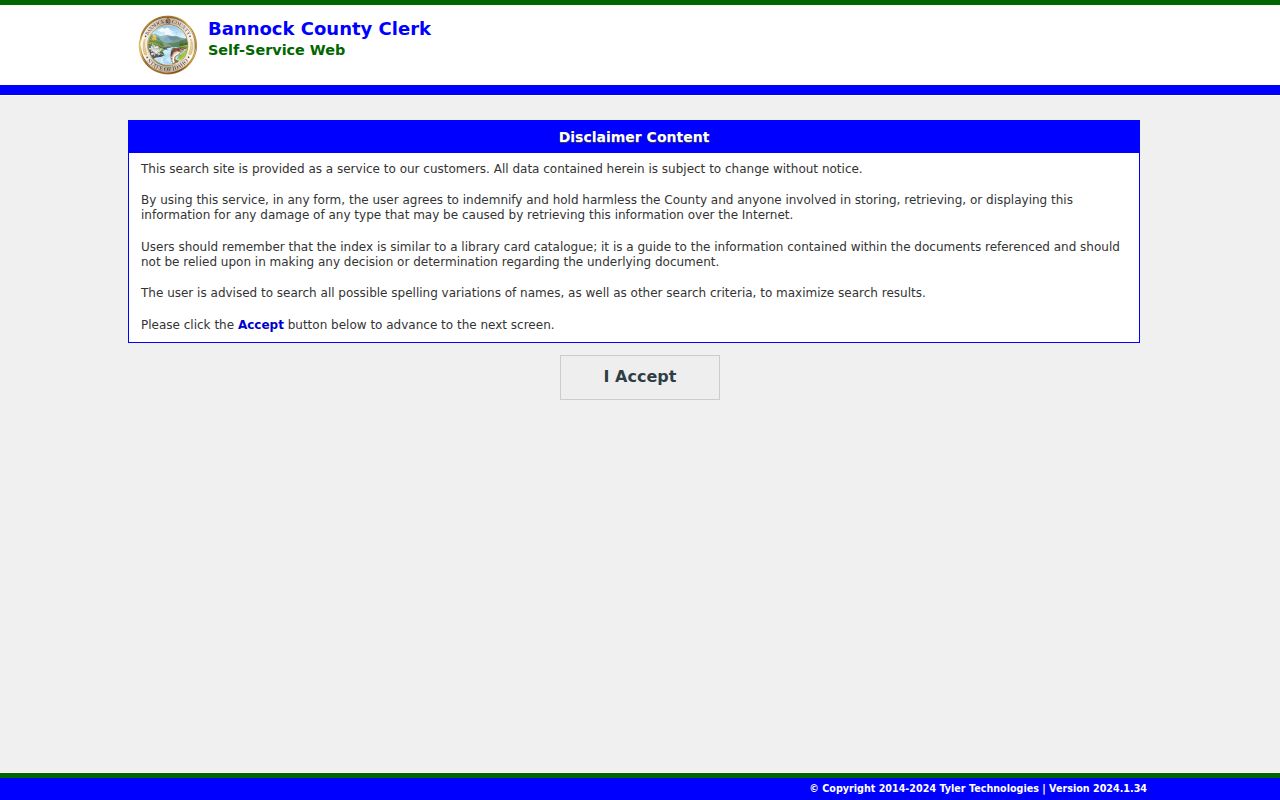
The county's entry screen gates the scanned-record search. The recorded deed beneath it remains the evidence that extends a former-owner chain.
Online cutoff. The precise earliest searchable year is unverified. When the online chain ends, continue through the Recorder's counter, vault and request channel.
Reverse a Bannock County Ownership Trail
Work the trail from grantee back to grantor. When a person owned several parcels or the address changed, the legal description settles which Bannock County parcel the transfer touched.
- Find the current parcel and save its legal description and deed-reference fields.
- Locate the newest deed and read the current grantee and prior grantor.
- Search that grantor as a grantee in an earlier period.
- Confirm that the earlier instrument describes the same land.
- Repeat until the online trail ends, then request the relevant deed book or microfilm.
- Grantor
- The party conveying an interest.
- Grantee
- The party receiving it.
- Reverse index
- An index organized to help search the grantor side of the record.
- Chain of title
- The linked sequence of instruments affecting the same land.
- Quitclaim
- A transfer of whatever interest the grantor has, without the promises associated with a warranty deed.
For a single recorded copy and the current fee schedule, turn to the Bannock County deed records page. Time depth stays the focus here.
Probate Can Bridge Bannock County Prior Owners
A clean sale-to-sale sequence is not guaranteed. Bannock County probate can bridge the gap when a former owner of record dies. A probate deed, personal-representative deed or heirship affidavit may connect the deceased owner with the next owner of the parcel. Search representative labels and estate names as indexed. Then compare the legal description. Court files explain the estate's authority, while the Recorder holds the instrument affecting the land, so the two trails complement each other and a docket alone never replaces the recorded chain.
Note: An estate transfer may preserve ownership continuity even when no ordinary buyer-and-seller deed appears between the two names.
Plats Track Bannock Parcels Through Splits
Owners can vanish from an address search after a lot split, replat, vacation or annexation. Recorded plats and surveys bridge the change. They show the subdivision name, lot, block, dedications, easements and monument notes tied to each Bannock County parcel. Compare the old description with current parcel geometry. Never assume the street address stayed constant. Bannock Planning links plat and records-of-survey viewers, and the Recorder's fee schedule lists separate plat, survey filing and survey-copy charges, confirming that map records belong to the recorded trail.
Use Pocatello Directories as Ownership Context
Historic directories can place a person at an address. They record occupants and listings, though, not legal title. The Idaho State Historical Society's Pocatello-area directory holdings later grew to cover Alameda, Chubbuck, Downey, Lava Hot Springs, McCammon and Rockland. Geographic coverage changed over the run.
Pocatello's 1890 townsite used a 600-block grid. It held 20 lots per block and a railroad divide. For an old house, weigh directory and newspaper clues against that historic street context. Translate the address to a modern situs and parcel before resuming the deed chain.
Request Older Bannock Ownership Records
The Recorder counter sits at 624 E Center, Room 211, Pocatello, open weekdays 8 a.m. to 5 p.m. excluding state holidays. Call 208-236-7358. Bring names, date ranges, legal descriptions and the last known recording reference. Copies run $1 per page. A certificate under seal adds $1. The county request page offers the written route. Idaho Public Records Law generally requires a response or acknowledgement within three working days, with notice of a longer response allowed, generally within ten working days. The Idaho State Archives and library holdings are later fallbacks for older county records, maps, directories and newspapers.
Search Bannock Names the Way the Index Stored Them
The Recorder's disclaimer says try every spelling variation. Former owners can hide behind initials, married names, trustee or personal-representative labels, and business suffixes. Record each version as found. Never silently normalize a name. The variation may explain why the next deed resists a Bannock County property search.
When two people share a name, compare the land description, the recording date and the other party to the transfer. Mailing addresses help as clues. They should not outweigh the legal description. A deed image often carries exceptions and execution details that the short index entry omits. Idaho Secretary of State business records can identify an entity named in a transfer. They prove no deed terms. They cannot show who benefited from a trust, so use the filing to refine a name search, then return to the land record.
Use Archives to Extend a Bannock House History
The Idaho State Archives collects county and city government records. It also holds maps, newspapers and genealogy sources under one roof. Its reconstructed 1890 Idaho census is a standout for Bannock County history. That project rebuilt lost names from land and tax records. The work drew on wills, court files, mining and water-right papers, vital events, naturalizations and newspapers.
The index can yield a nineteenth-century name lead that predates the modern tax roll. Treat it as context, though. Pull the source the index cites. Then tie the name to the parcel with a deed, a land description or a plat. Newspapers and directories show who lived at or used a place. They do not prove who held title.
Suppose the Recorder vault, the archives and the directory trail still leave a gap. Say so plainly. A sound chain names the missing transfer. It does not assume a resident or a next-door owner held title.
Know What Bannock Former-Owner Records Prove
A Bannock former-owner sequence is only as strong as the instruments behind it. An index can drop full exceptions, consideration language, and legal text. An old directory may list an occupant. That person may never have held the deed. And an assessor history can mirror roll treatment. It may not reflect every transfer in between.
Lawful use. Bannock County former-owner research supports house history, estate work and property diligence. Do not use it to track, stalk, harass or harm a living person.
For a title opinion or a break you cannot resolve, rely on the recorded documents themselves, or bring in qualified Idaho title or legal help.