
Fields in Bannock County Property Tax Records
Two offices split the work in Bannock County. The Assessor sets each parcel's value and decides exemption treatment, and the Treasurer then bills and collects whatever charge results. Every number sits beside a tax year, and a current parcel result also exposes prior values and prior tax charges, so read the year label before comparing anything.
| Field | What it means | Custodian |
|---|---|---|
| Land value | Value assigned to the land portion | Assessor |
| Improvement value | Value assigned to buildings and improvements | Assessor |
| Market and assessed value | County valuation fields for the stated year | Assessor |
| Exemption | Approved reduction in taxable treatment | Assessor |
| Tax charge and status | Amount billed, paid, or delinquent | Treasurer |
Bannock parcel data carries current and four prior assessed-value fields, with five matching tax-charge years. CurMktValue is not a verified sale price. Any recorded consideration belongs in the deed itself.
Five Tax Years Appear in Bannock Parcel Data
The county's official parcel feature service names fields for the current tax charge, the prior year, and three earlier ones, and matching value fields reach back four prior years. Search by the parcel PIN or parcel number. Similar street addresses get confused far less that way. The public Bannock County Parcel Viewer lays out that parcel context on a map.
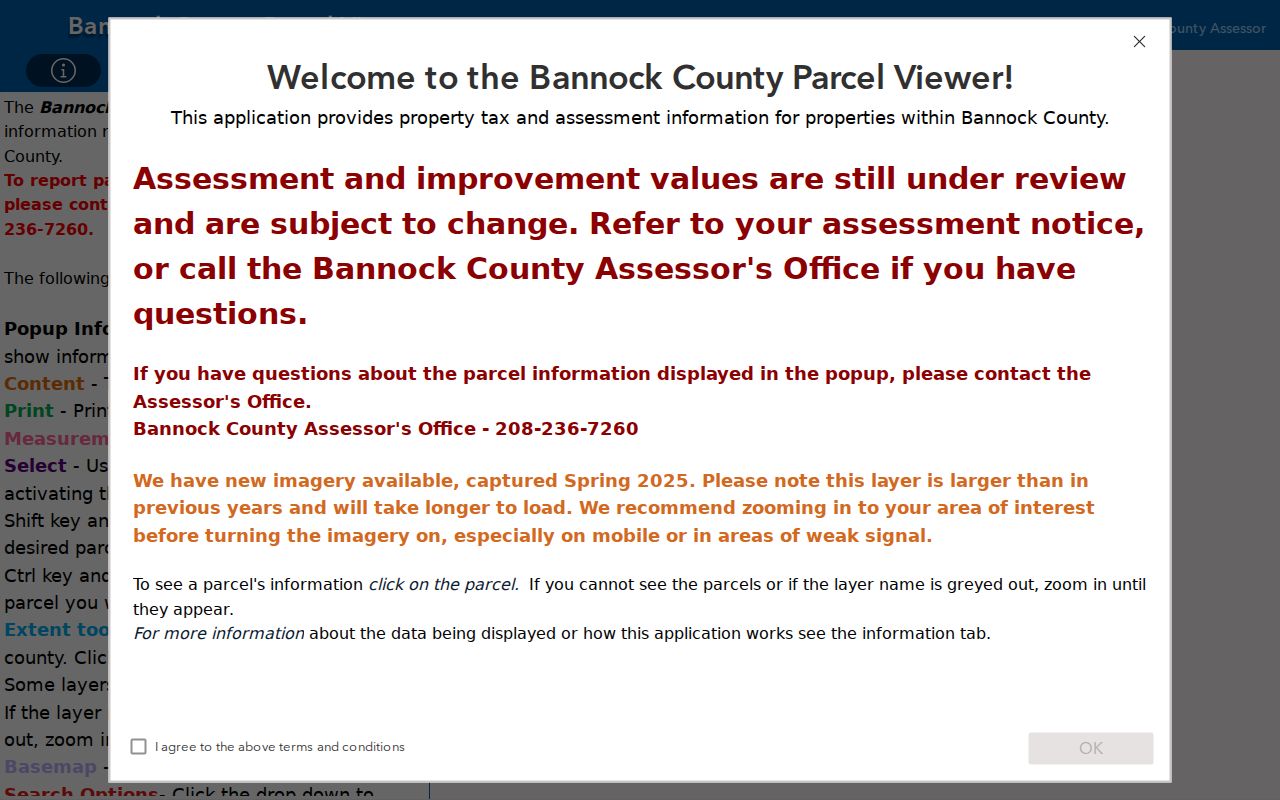
That map layers tax history beside owner, situs, mailing, legal-description, and building fields. The Treasurer still holds the live amount due, so treat the viewer as context rather than a balance source. Note: Compare like years, because tax-charge, assessed-value, and market fields may reflect different points in the annual cycle.
January 1 Anchors Idaho Property Value
Idaho property is assessed according to its status on January 1. That date is the lien date. The Assessor describes assessed value as essentially market value for tax purposes. Local taxing-district budgets and taxable value then produce the rate. A levy is simply the combined rate. It is applied to taxable value.
- Assessed value
- The value placed on the roll for the year.
- Taxable value
- The amount remaining after approved exemptions or adjustments.
- Levy
- The rate produced by applicable district budgets and the tax base.
- Tax lien
- The statutory claim securing unpaid property tax.
Look Up a Bannock County Tax Account
The county publishes no complete public bill search. Begin with the parcel viewer, then go through the Treasurer's own channels rather than treating any third-party result as the live county balance.
- Find the address and save its parcel PIN, parcel number, assessed value, and tax-charge year.
- Contact the Bannock County Treasurer with that key to confirm the current bill and payment status.
- Compare the Assessor record for any exemption and effective year.
- Ask for current payoff or tax-sale details when delinquency, interest, or late charges are involved.
The Treasurer's office sits at 624 E Center Street, Room 203, in Pocatello, and answers at 208-236-7220. Payments work by mail, at the counter, by check, or through an online card vendor. Electronic checks are not accepted.
The Second-Half Statement Is Not Mailed
Bills issue by the fourth Monday in November. The first half is ordinarily due December 20. The second half comes due June 20. Bannock County never mails a second-half statement, so mark the date yourself. In 2026 the published deadline moved to June 22. June 20 fell on a weekend.
A late installment draws a 2 percent charge. Delinquent tax accrues 1 percent interest each month. Partial delinquent payments and prepayments of at least $25 are accepted. Interest keeps running on whatever balance remains unpaid.
Save the June date. Paying the first installment does not produce a mailed reminder for Bannock County's second half.
Bannock's Homeowner Exemption Can Reset
Idaho's homeowner exemption can cover 50 percent of a home and up to one acre. It is capped at $125,000 under Idaho Code §63-602G. The Assessor handles eligibility and applications. The exemption ends when ownership changes, the owner moves, the property goes into a trust, or an owner is added. Reapplication may be needed after any of those events. A status on the roll is only a clue to tax treatment. It is not proof that a person now occupies the site. Contact the Bannock County Assessor at 208-236-7260 for current forms and proof requirements. Note: Check the effective year and ownership configuration before assuming an older exemption still applies.
Delinquent Tax Requires a Live Confirmation
A historical tax-charge field cannot show a full balance. Interest, late charges, partial payments, and a pending tax-deed process all change the number. Ask the Treasurer for status as of a stated date, and request the underlying public record when the county site does not expose it. The official Treasurer page documents the county route.
Keep the confirmation date with any payoff or delinquency response. The amount can shift as interest posts or a payment clears.
Appeal a Bannock County Assessment on Time
An assessment notice deserves a close read. Factual or valuation concerns should first go to the Assessor. That office can often clear up errors before anything formal begins. A formal appeal goes to the Bannock County Board of Equalization. The filing deadline is the fourth Monday in June. The strongest evidence speaks to the parcel's condition on January 1. That may be a factual error in the record, documented damage or condition issues, or market comparisons from similar sales.
The filing date controls. A Bannock County assessment appeal must reach the Board of Equalization by the fourth Monday in June.
An appeal disputes assessed value, not a Treasurer bill caused by a missed installment. Ownership and legal-boundary disputes may call for recorded instruments or a survey instead of a valuation appeal.
Use the Counter, Phone, and Records Request
The parcel viewer costs nothing to use. The Assessor counter at 130 North 6th Avenue in Pocatello is open weekdays from 8 a.m. to 5 p.m. The Treasurer sits in Room 203 at 624 E Center Street. An installment, exemption, or current balance may not be confirmed online. A phone call is often the fastest fallback. For a larger or nonstandard set of records, use Bannock County's public-record request process under the Idaho Public Records Law. The Idaho State Tax Commission supplies state guidance. The county offices remain custodians of the local assessment and bill.
Land and Improvement Values Explain the Total
Each Bannock County parcel result shows land value, improvement value, and a total market figure. Land is the site itself. Improvements are taxable structures and their additions. Read all three together before crediting a swing to the wider market. A remodel or a demolition can shift one piece. A corrected building fact or a parcel change can do the same. The rest may hold steady. The same property records result also lists year built, floor area, bedrooms, baths, garage capacity, and mapped acreage.
Those fields can flag a possible data problem. They cannot replace a physical inspection. Bring a factual concern to the Assessor. Keep the result date, parcel number, and the exact source field handy.
Taxing Districts Make Bannock Rates Parcel-Specific
A single property in Bannock County can sit inside several taxing districts at once. Each district sets a budget. Those budgets, pooled with taxable values, produce the levy on that particular parcel. So two properties assessed at nearly the same value can still carry different tax bills. School district lines, city limits, and special districts shift the mix. This holds even for owners who share a mailing city.
Check the parcel's district list and assessment year before comparing charges. A postal address never settles jurisdiction. Use the GIS map as a reference. Then ask the responsible county office to confirm the official boundary assignment.
A Tax Charge Is Not a Payment Ledger
The public parcel layer publishes an annual tax charge. It does not record each payment event. Installment timing, partial payments, late fees, accrued interest, and later corrections can all change the Treasurer's live balance. Treat the published charge as one dated field. Get payment status straight from the Treasurer.
Anyone buying or selling should request confirmation close to the transaction date. A screenshot saved weeks earlier may miss a cleared payment or fresh interest. When a tax deed or delinquent-property process is in question, ask for the notice and timeline instead of inferring status from one annual figure.
Match Appeal Evidence to January 1
An assessment appeal works best with evidence matching the roll's date and property facts. The date is January 1. Start with the legal description, parcel area, improvement details, and any exemption treatment. Then build the case around January 1 with comparable sales or documented condition evidence. A later remodel or sale adds context. It may not describe the parcel on the valuation date.
File the notice, the parcel result, the supporting material, and Assessor correspondence in one place. The Board of Equalization handles the assessment dispute. Payment posting and delinquent balances belong to the Treasurer. An ownership correction may require a deed through the Recorder.