
Decode Bannock County Property Values
One parcel can carry several numbers. The Assessor estimates market value for the annual tax roll. Idaho generally assesses real property at full market value. That mass appraisal still differs from a private appraisal done for a single sale. The public parcel layer adds detail. It breaks the current figure into land and improvement amounts. It publishes four prior value fields too. A recorded deed may show consideration from a transfer. The county publishes no sale-price field on every parcel result.
| Value | What It Is | Where |
|---|---|---|
| Assessed value | County estimate used in the property-tax system | Assessor roll |
| Market value | Mass-appraisal estimate of full market value | Assessor and parcel layer |
| Last sale price | Consideration tied to a recorded transfer, when stated | Recorder deed |
| Land and improvements | Separate components for the site and structures | Parcel result |
These terms overlap in Idaho tax practice. Keep the year and source beside the number. A current county estimate can differ from an older sale because market conditions, physical changes, or the assessment date moved. The better question is not simply what a property is worth. Ask which value, for which year, from which record. The county's current Parcel Viewer is the official starting point for matching values to the right parcel.
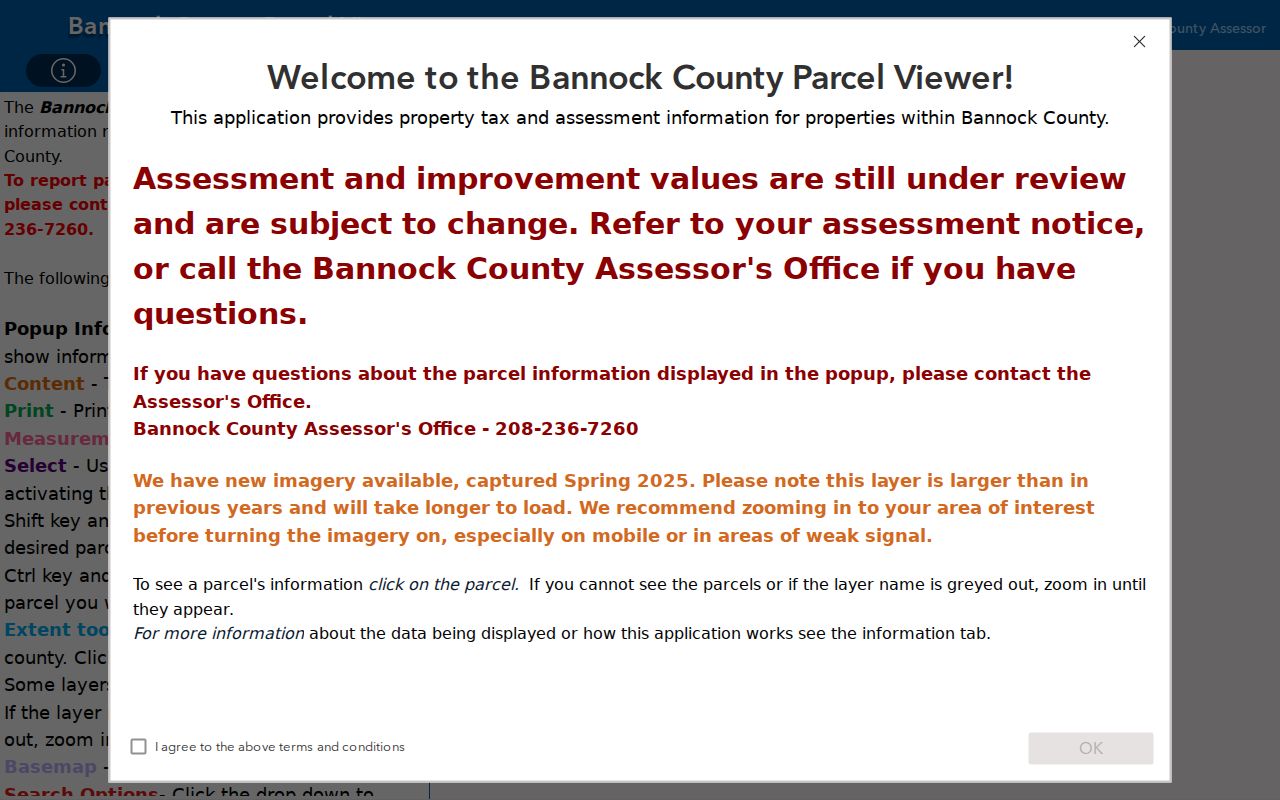
The viewer names the county as its source. That keeps every value lookup tied to the mapped parcel before any comparison begins.
Bannock County Value Fields
The public Bannock parcel layer exposes a useful value history. Current fields cover land, improvement, and total market value. Four prior sets preserve earlier value and tax-charge figures. That builds a quick trend line. Building characteristics and legal-description fields help confirm the history belongs to the intended parcel.
Check the parcel number, situs address, and legal description before reading the series. A split, combination, new improvement, or corrected account can make year-to-year swings look bigger than an ordinary market adjustment. Treat prior fields as roll snapshots. They show what the county displayed, not the price a buyer would have paid.
Four-year view. Save the current parcel key with each prior value so a later parcel change does not erase the context.
January Sets Bannock County Value
Idaho sets January 1 as the property-tax lien and valuation date. The Bannock County Assessor values property for the assessment roll and mails notices under the state timetable. A remodel finished later, a midyear sale, or a sudden demand shift may fall outside the date the current roll represents.
The date rule resolves many apparent conflicts. A deed records a transaction date. A private appraisal carries its own effective date. The assessor value reflects the statutory roll date. Hold all three dates in view when comparing a Bannock County property value during a purchase, estate review, or tax appeal.
Note: The roll date is a reference point, not a promise that every parcel characteristic was inspected on that day.
Land and Buildings Split
Bannock County separates land value from improvement value. Land reflects the site itself. Improvements generally cover buildings and other taxable additions. Their sum produces the total shown in the public parcel schema. This split helps explain a change after construction, demolition, or a parcel adjustment, though it does not itemize the cost of each feature.
Use building facts as a cross-check. The parcel service publishes characteristics beside the value fields, so a reader can spot whether the record describes the expected structure. If something looks wrong, contact the Assessor rather than trying to fix a county value through the Recorder or Treasurer.
Look Up Bannock County Value
Begin with the Bannock County Parcel Viewer. An address works fine. A parcel number is safer when street spelling or mailing geography causes doubt. The result ties the value to an owner-of-record field, situs address, mailing address, parcel identifiers, and legal description.
- Search the situs address, then verify the mapped parcel shape.
- Save Parcel_PIN or PARCEL_NO and the legal description.
- Read current land, improvement, and total value with the roll year.
- Compare the four prior value fields without treating them as sale prices.
- For transfer consideration, cross-check the latest deed in the Recorder index.
- Assessed value
- The county value used within the tax system.
- Market value
- The Assessor's mass-appraisal estimate of full value.
- Assessment ratio
- The relationship between assessed and market value.
- Consideration
- The amount stated in a transfer instrument, when the deed discloses it.
- Reassessment
- A later valuation of the parcel for a new roll.
Prior Bannock County Value History
The four prior value fields are a strong local feature. Read them as a sequence alongside current land, improvement, and total values. The same parcel service exposes current and prior tax-charge fields. A charge is not a value. Mixing those columns produces a false trend.
A jump in improvement value may point to work worth checking in permit files. Pocatello offers eTRAKiT project searches. Chubbuck uses SmartGov. McCammon leans on forms and clerk requests. Those city records can explain physical work, but they never replace the county assessment. An old Pocatello historic-district file adds context without setting today's value.
Sale Price Lives in Deeds
A deed and a tax roll answer different questions. The deed documents a legal transfer and may state the consideration paid. The roll carries a county valuation used for tax administration. To pull the instrument, search the Bannock County Self-Service land-record portal by owner name or recording reference, then read the deed itself rather than trusting the catalogue entry.
Records created since 1999 are scanned and viewable online, according to the Recorder. The portal advises trying spelling variants when a name search comes up empty. Older or murky transfers still take a trip to the Recorder counter, a copy request, or the deed books and archives. Keep in mind that a nominal sale price, family transfer, trust deed, or estate instrument may not reflect an open-market sale at all.
Exemptions Change Taxable Amounts
Idaho's homeowner exemption can cover half the value of a qualifying home plus up to one acre. It is capped at $125,000 under Idaho Code §63-602G. That subtraction changes taxable value. It does not lower the assessor's estimate of full market value, because the market itself has not moved.
The exemption ends when ownership changes. It also ends if the owner moves or the ownership configuration shifts, so a buyer must reapply after a sale. Roll treatment is therefore a clue, not proof of occupancy. For bill amounts, deadlines, or an appeal, see the dedicated Bannock County property tax records resource.
Limits of Bannock County Values
The Assessor relies on mass appraisal across many parcels. A licensed appraiser inspects one property for a specific purpose and effective date. Neither the GIS outline nor CurMktValue proves a surveyed boundary, the condition of improvements, clear title, or a future sale price. Surveyors, title professionals, inspectors, and buyers handle those questions.
Confirm the parcel number first. Keep the roll year attached to every figure. Say whether a number came from the Assessor or a deed. That discipline turns a Bannock County property value into useful evidence without asking the public record to prove more than it can.
Value is not price. A Bannock County assessed value supports taxation. It is not a sale forecast or a private appraisal.